
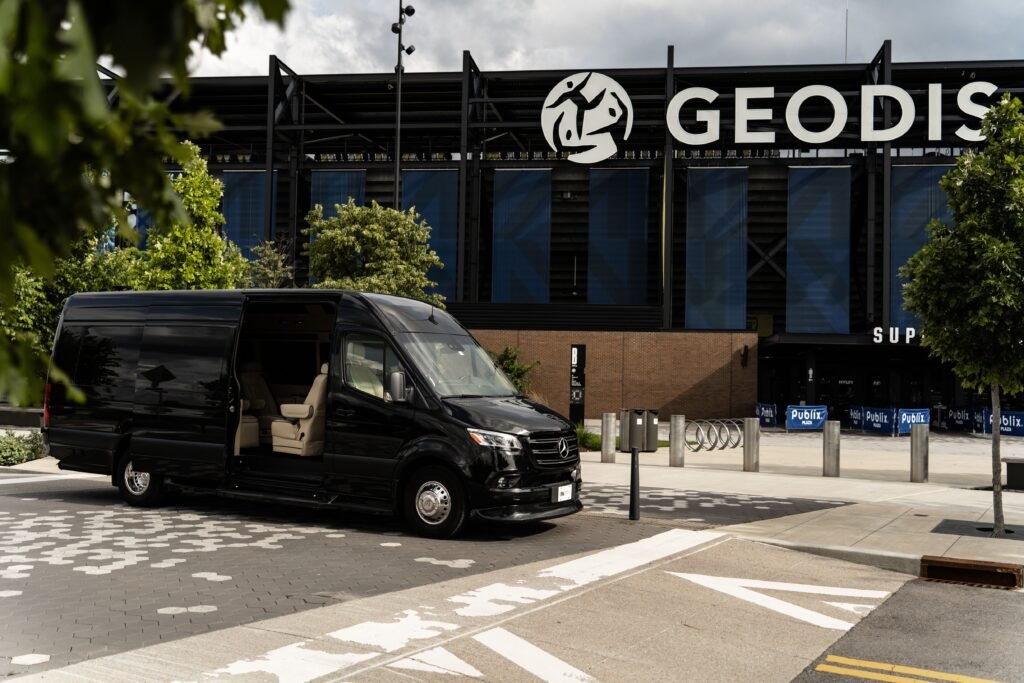
One operator’s vehicle choice is reshaping client expectations in a market that has historically been dominated by the sedan and the SUV. Here is what is driving the shift and what it means for the industry.
Nashville has never been a typical ground transportation market.
It is the healthcare capital of the United States. It is one of the fastest-growing private aviation markets in the Southeast. It has produced, over the last decade, one of the most concentrated populations of high-net-worth executives and entrepreneurs of any mid-size American city. And it has done all of this while its ground transportation market, until recently, looked more or less like every other market of its size: black sedans, Escalades, a handful of Sprinter shuttles configured for group transfers, and the standard service model that the industry has operated on for thirty years.
That is changing. And the vehicle at the center of the change is the Jet-Style Sprinter.
The Vehicle and the Philosophy Behind It
The Jet-Style Sprinter is not a new product category. Operators in New York, Los Angeles, and Chicago have offered executive-configured Sprinter vans for years, and the broader market is familiar with the format. What is different about the way STS Nashville has deployed it in the Nashville market is the philosophy driving the configuration and the client segment it is specifically designed to serve.
STS Nashville founder Luke Robinson built the company in 2023 around a specific insight: that the ceiling of executive ground transportation in Nashville was not being set by what was technically possible, but by what the industry had historically assumed its clients would accept. Clean vehicle, professional driver, punctual service. The absence of problems rather than the presence of something exceptional.
The Jet-Style Sprinter was chosen as the flagship vehicle specifically because it is the ground transportation product that most closely replicates the private aviation cabin experience. Individual leather captain’s chairs with genuine personal space. A central lounge table that makes working in the vehicle genuinely practical rather than aspirational. Acoustic insulation that creates a cabin quiet enough for sensitive calls and focused preparation. Ambient LED lighting on an adjustable spectrum. An onboard private restroom that removes the logistics variable from any transfer over 90 minutes.
The configuration is not borrowed from the ground transportation industry’s design vocabulary. It is borrowed from private aviation. And in a market where a significant and growing share of the client base arrives in Nashville on private aircraft, that design choice is not incidental. It is the operational logic of the entire service.
The Nashville Market Context
Understanding why this vehicle has found its audience in Nashville requires understanding what Nashville’s executive transportation market actually looks like in 2026.
Nashville International Airport handled more than 20 million passengers in recent years, and its FBO operations at Signature Flight Support and Jet Aviation have grown alongside the city’s expanding high-net-worth residential and corporate base. The executives who arrive at Nashville’s FBO terminals have a specific and consistent reference point for what ground transportation should feel like: whatever they just left. A ground vehicle that falls meaningfully short of that reference point is not a minor disappointment. It is a gap that registers immediately and colors the entire arrival experience.
The residential geography compounds this dynamic. Belle Meade, Green Hills, Brentwood, and Franklin form a luxury residential and corporate corridor south of downtown Nashville that rivals any comparable geography in the Southeast for the concentration of C-suite executives, healthcare company leadership, private equity professionals, and high-net-worth entrepreneurs it contains. These clients travel with frequency and intensity. They have upgraded every other service category in their professional lives to the highest available standard. Ground transportation has historically been the last category to be upgraded, partly because the gap between adequate and excellent was narrow enough that the upgrade did not feel urgent.
The Jet-Style Sprinter widens that gap significantly. And once a client has experienced the difference, the old standard does not feel adequate anymore.
What the Operator Has Observed
The client behavior patterns that STS Nashville has observed since deploying the Jet-Style Sprinter as the flagship vehicle offer some instructive data points for operators considering a similar configuration.
The first is the conversion to standing weekly reservations. The transition from one-time or occasional bookings to standing weekly arrangements happens significantly faster with Jet-Style Sprinter clients than with clients who book the Escalade or sedan. The working environment that the Sprinter cabin provides is the primary driver of this conversion: once a client has used the vehicle for a full-day executive booking and experienced the productive use of transit time that the lounge table and cabin environment enable, the cost-benefit calculation of a standing weekly reservation resolves itself quickly.
The second is the FBO client retention rate. Private aviation clients who use the Jet-Style Sprinter for their Nashville FBO arrival transfer return at a meaningfully higher rate than those served by standard vehicles. The explanation is straightforward: the vehicle meets their reference point rather than falling short of it, which means the ground transfer does not create the low-grade friction that a standard vehicle arrival after a private flight typically generates.
The third is the group dynamic effect. Corporate groups that use the Jet-Style Sprinter for roadshows, board meeting transfers, and multi-stop executive days consistently report that the lounge configuration changes the character of the transit time in ways that translate directly into meeting performance. The pre-meeting conversation happens in the cabin. The post-meeting debrief is captured on the return journey. The vehicle becomes part of the working day rather than a gap in it.
The Operational Considerations
For operators evaluating the Jet-Style Sprinter configuration, the Nashville experience surfaces several operational considerations worth noting.
Vehicle positioning in the market. The Jet-Style Sprinter commands a premium that is justified by the cabin experience but requires clear market positioning to convert. The clients who respond to it are not the clients who are shopping primarily on price. They are the clients who have a strong reference point for quality and recognize immediately when a product meets that reference point. Marketing the vehicle to this segment requires content and positioning that speaks to the cabin experience and the private aviation comparison directly rather than to the vehicle category generically.
The chauffeur relationship as the compounding variable. The Jet-Style Sprinter’s cabin environment is most fully realized when the chauffeur relationship has developed to the point where the briefing conversation has disappeared and the preferences are already known and applied automatically. Operators who deploy the vehicle as a premium product without investing equivalently in the chauffeur training and client relationship protocols that the vehicle requires will find that the cabin experience does not deliver its full value. The vehicle and the service level are inseparable.
The standing reservation model as the primary revenue structure. The Jet-Style Sprinter is most profitable and most operationally efficient when it is deployed on standing weekly reservations rather than on individual bookings. The predictability of the standing model allows for vehicle preparation, chauffeur assignment, and routing optimization that individual bookings cannot support at the same level. Operators considering this configuration should build their sales and account management process around the standing reservation conversion from the first booking.
Fleet integration. The Jet-Style Sprinter does not replace the Escalade or the executive sedan in a well-configured fleet. It occupies a different position for a different use case. The Escalade remains the right vehicle for solo executive transfers, airport point-to-point runs, and any engagement where a lower profile and faster urban maneuverability are priorities. The Jet-Style Sprinter takes over for groups of three or more, full-day bookings, city-to-city routes, and any engagement where the cabin environment needs to function as a working or social space. Operators who understand this distinction and position both vehicles clearly will find that the fleet serves a wider range of client needs more precisely than either vehicle does alone.
The Market Signal
The Jet-Style Sprinter’s reception in Nashville’s executive market carries a signal that extends beyond a single operator’s product choice.
The clients who have adopted it as their standard have not done so because it is a novelty or because it is the newest thing available. They have done so because it resolves a genuine gap between what they knew executive ground transportation could be and what the market had historically offered them. That gap existed in Nashville’s market for years before the Jet-Style Sprinter arrived in it. It almost certainly exists in other markets of comparable scale and client profile.
The private aviation comparison is the most useful frame for operators thinking about where this product category goes next. Private aviation did not grow by offering a more comfortable version of commercial flying. It grew by offering a fundamentally different relationship between the traveler and the in-transit experience, one where the time in the vehicle was genuinely the traveler’s time rather than time to be endured.
The Jet-Style Sprinter, configured and operated at the level that the Nashville experience has demonstrated is possible, offers something similar for ground transportation. Not a more comfortable version of the standard. A different relationship with the in-transit experience entirely.
For operators in markets with the right client profile, that is a meaningful product opportunity. Nashville is showing what it looks like when the market is ready for it.
For more information on STS Nashville’s executive ground transportation service in Nashville, including the Jet-Style Sprinter, FBO arrival protocols, and corporate account arrangements, visit nashvillechauffeurservice.com.