
Chauffeur Digest: Donald, thank you for making time for us. Let’s start at the beginning. Albania is a country many in the global ground transportation industry are only now starting to pay attention to. What made you see the opportunity there back in 2021?
Donald Merdanaj: It was a combination of timing and frustration, honestly. I could see very clearly that Albania was about to experience something significant. The tourism numbers were climbing every year, more and more European travelers were discovering the country, and Tirana International Airport was getting busier every season. But if you arrived at that airport as an international visitor, the experience of getting to your destination was completely unpredictable. There were no pre-booked options. You negotiated with a taxi driver at arrivals, with no way to know if the price was fair, no confirmation, no safety guarantee. For a country that wanted to compete with Croatia, Greece, and Montenegro for the European tourism market, that was a serious problem.
CD: So you stepped in to fill that gap.
DM: That is exactly it. I believed Albania was going to become one of Europe’s most exciting travel destinations, and I wanted to build the infrastructure that travelers deserved. Not a taxi company. A professional private transfer service with transparent pricing, licensed drivers, confirmed bookings, and a standard of care that international visitors would recognize from more established markets.
CD: How difficult was it to establish that standard in a market where it did not really exist yet?
DM: Very difficult at first, and I think it is important to be honest about that. When there is no existing benchmark, you are educating customers and building trust simultaneously. International travelers coming to Albania for the first time had learned to be cautious about transportation, because their experience told them to be. So we had to work harder to earn confidence. The way we did that was through consistency. Every booking was personally reviewed. Every driver was vetted and licensed. Every flight was tracked. And when something went wrong — a delayed flight, a change of address, an unexpected request — we handled it professionally, every single time. The reviews came from that consistency, and the reviews built the business.
CD: Tell us about the operations side. How does the business actually work day to day?
DM: The core of what we do is matching the right driver and vehicle to the right passenger at the right time, and then making sure everything around that match is handled seamlessly. When a customer books, our operations team reviews the booking personally. We verify the flight number, the destination, the number of passengers, any special requirements. We confirm the vehicle class. And we set up real-time flight monitoring so that if that flight is delayed — at midnight, at five in the morning, whenever — the driver is informed automatically and adjusts accordingly. The customer never has to call us. They never have to worry about whether their driver knows they are running late.
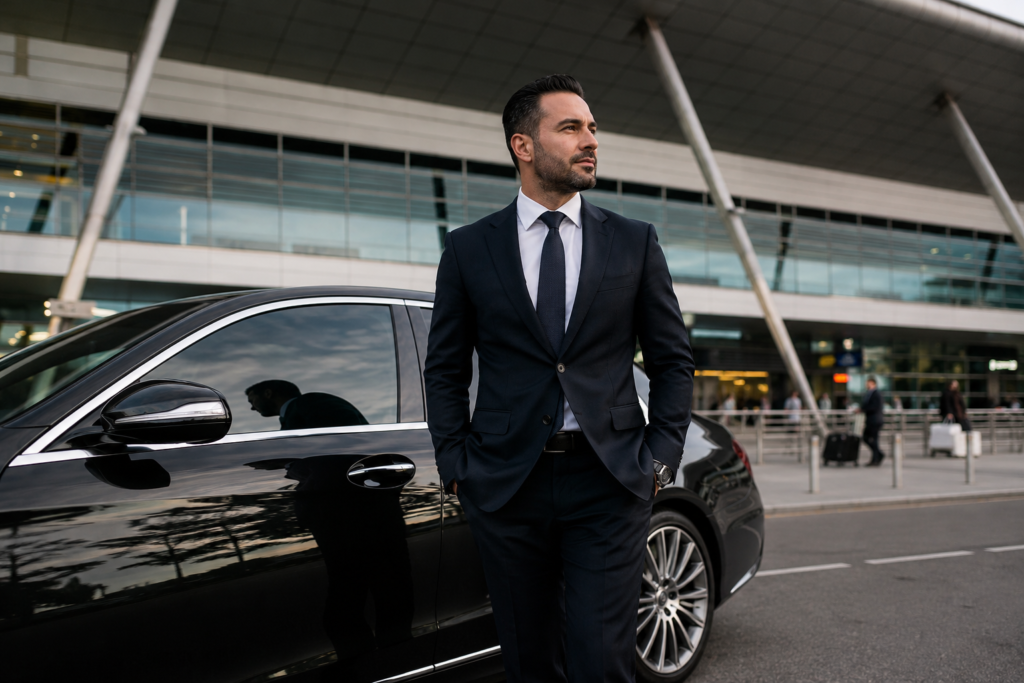
From the driver’s side, they arrive at Tirana International Airport with a personalized name sign and wait outside the arrivals hall. When the passenger clears customs, they see their name, they meet their driver, their luggage is handled, and they are on their way. That process should feel effortless, and our job is to do all the work that makes it feel effortless.
CD: Let’s talk about the routes you cover. Albania is a geographically diverse country. What does your service area actually look like?
DM: We cover the entire country from Tirana Airport. The most requested routes are to the city center, Durres, and the Albanian Riviera destinations — Sarande, Ksamil, Dhermi, Himare, Vlore. But we also operate extensively to Berat, the UNESCO World Heritage city in central Albania, Shkoder in the north, and routes into the Albanian Alps toward Theth and Valbona for adventure travelers. Some of our transfers are twenty-five minutes. Others are nearly four hours, all the way down the coast to Ksamil. The standard of service is identical regardless of the distance.
CD: How do you manage vehicle and driver quality across such a geographically spread operation?
DM: We work with a trusted network of drivers who have been with us since the early stages of the business. Every one of them is professionally licensed, background-checked, and assessed regularly. They speak English, Albanian, and Italian. They know the roads. And critically, they understand the standard we expect. On a long route — Tirana to Sarande, Tirana to Himare, over the Llogara Pass — the quality of the driver is everything. It is not just about reaching the destination safely. It is about the passenger feeling comfortable and confident for three hours in a vehicle. Our drivers deliver that.
CD: What does your typical customer look like?
DM: We have a genuinely wide range. International tourists are the core, people arriving from the UK, Germany, Italy, France, the Netherlands, Scandinavia — most of them visiting Albania for the first time, many of them traveling in couples or small groups. Families with children are a significant and growing segment, and we provide free child seats on request as standard. We also serve a meaningful number of business travelers who need punctuality and professionalism above everything else.
Then there are the adventure travelers, which I find particularly interesting as a segment. Albania is increasingly on the radar of serious trekkers and outdoor enthusiasts, people heading to Theth and Valbona in the Albanian Alps, and they want a driver who knows the mountain roads and can give them honest information about conditions. Our drivers are that resource.
And finally, we work with travel agencies and tour operators who are building group itineraries across Albania. That partnership side of the business has grown considerably because agencies want a partner they can rely on without having to micromanage every detail. We give them that reliability.
CD: You mentioned families and child seats. What else do you offer beyond the transfer itself in terms of added value?
DM: Complimentary bottled water on every journey. Free child seats across all vehicle classes. Flight delay management at no extra cost. A Meet and Greet service inside the arrivals hall with a personalized name sign. Assistance with luggage. Full 24/7 customer support via phone, email, and WhatsApp. And on longer routes, our drivers genuinely act as informal guides — they know the best viewpoints, the authentic restaurants, the beaches that are not in the guidebooks. Many customers tell us afterwards that the conversation with their driver was one of the highlights of their trip. That is something you cannot script. It comes from hiring people who are proud of their country and enjoy sharing it.
CD: Pricing is always a complex topic in this industry. How do you approach it?
DM: Fixed pricing, always. The customer sees their fare at the time of booking, and that is the fare they pay. No meters, no surge pricing, no toll add-ons, no luggage surcharges. The fixed price model was a deliberate decision from the start, because the alternative — negotiated or metered fares — is exactly what created the problem we were trying to solve. Transparency is a trust signal, and trust is the product we are really selling. When a traveler books with us, they are not just buying a seat in a car. They are buying certainty. And certainty has to have a fixed price.
CD: Looking at where the industry is heading globally, what trends are you watching most closely?
DM: The most significant one for our market is the continued and accelerating growth of Albanian tourism. The numbers are extraordinary. Albania welcomed more international visitors in recent years than at any point in its history, and that trajectory is not slowing. Tirana International Airport is expanding. New boutique hotels and villa rentals are opening all along the Riviera. High-spending travelers from Western Europe are increasingly choosing Albania over more saturated destinations. All of that creates demand for professional ground transportation, and we intend to grow alongside it.
Separately, I am paying close attention to how the industry is evolving in terms of customer communication. WhatsApp has become our most important booking channel alongside the website. Travelers want to message, not call. They want to receive their confirmation and ask a quick question in the same app. Being genuinely responsive and personal in those channels is a competitive advantage that larger, more automated platforms struggle to replicate.
CD: What has been the most unexpected lesson you have learned since founding the business?
DM: That the relationship between a driver and a passenger can leave a much deeper impression than you would ever expect from a transfer lasting a few hours. I have received messages from customers months after their trip telling me that their driver recommended a restaurant they still think about, or suggested a beach they had not planned to visit that turned out to be the highlight of their holiday. That kind of impact is not something you plan for in a business model. But once you see it happening, you realize it is the most valuable thing you can cultivate. It is why we invest in our drivers as people, not just as operators.
CD: Finally, what does success look like for Tirana Airport Shuttle over the next five years?
DM: I want Tirana Airport Shuttle to be the first name that comes to mind when any international traveler — anywhere in the world — asks how to get from Tirana Airport to their destination. Not just one of the options. The obvious choice. That means continuing to build our reputation on the ground in Albania, deepening our partnerships with hotels and travel agencies, and ensuring that as the number of passengers arriving at TIA grows, our service scales without any reduction in the personal attention that has defined us from the beginning.
Albania is an extraordinary country. It deserves a transfer service that reflects that. We are building it.