
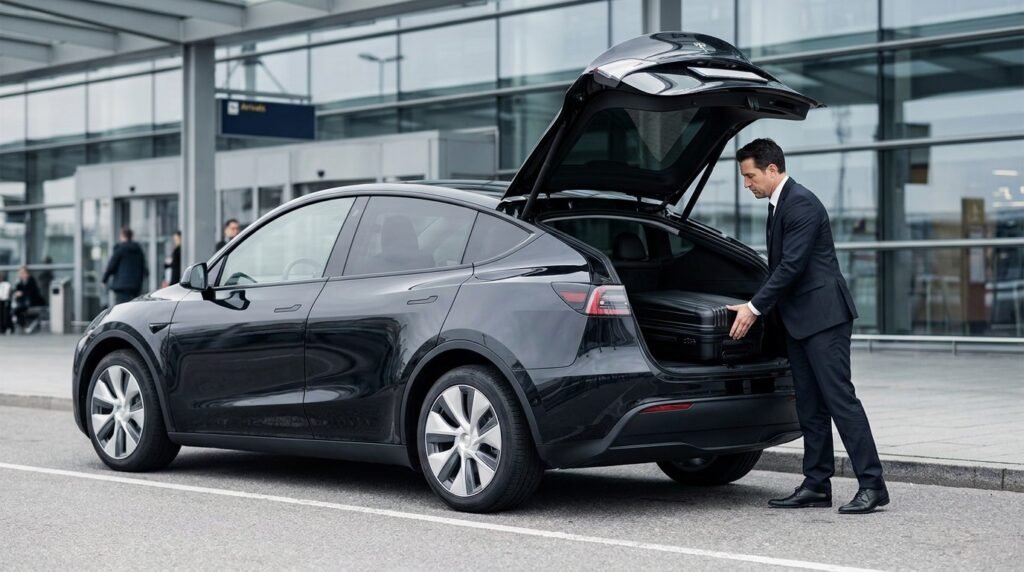
Most operators who go electric do it one vehicle at a time, adding an EV or two to a mixed fleet and watching how it performs before committing further. Costanova Transfer, a private transfer company based in Benidorm on Spain’s Costa Blanca, skipped that step entirely. Every vehicle in its fleet, a Tesla Model Y and Tesla Model 3, is fully electric, and it has been that way from the start.
A market built for it, whether anyone planned it that way or not
Costanova was founded to fill a specific gap: modern, fully electric executive transfers with professional drivers and transparent, fixed pricing across a coastline better known for package tourism than for premium ground transport. The company runs private, pre-booked transfers between Alicante Airport, Alicante’s RENFE train station, Valencia Airport, and towns up and down the Costa Blanca, along with custom intercity rides between towns that don’t touch an airport at all.
What makes the business a useful case study for other operators isn’t the vehicles themselves, it’s the route profile they run on. Airport transfers on the Costa Blanca are short by international standards, most routes run somewhere between 50 and 150 kilometres one way, and they’re booked in advance with a known destination and a known departure window. That combination removes most of the operational headaches that make electrification harder for operators running longer, less predictable jobs: there’s little range anxiety on a fixed, pre-planned route, and a driver returning from a Benidorm or Calpe run has a natural window to charge before the next booking.
Fixed pricing did more than simplify billing
Every route Costanova runs has a fixed, published price, agreed before the client travels rather than metered on arrival. For the business, that decision turned out to reinforce the electric positioning rather than compete with it. A fixed-price, pre-booked model and a fully electric fleet share the same underlying logic: both remove uncertainty for the client. No surprise on the fare, no surprise on the ride. In a market where the default alternative is a metered taxi rank at the airport, that combination has become the company’s clearest point of difference, not the fact that the cars happen to be electric, but what running electric allows the whole booking experience to look like.
The vehicle choice, and what it trades off
The fleet is currently split between the Tesla Model Y and Tesla Model 3, chosen for passenger comfort, reliability, and a quieter, more modern ride than a typical combustion-engine estate or saloon in the same class. The trade-off operators considering a similar move should expect: luggage capacity varies meaningfully between the two models, and for a market built on airport transfers, where a group of four with a week’s worth of luggage is a routine booking rather than an edge case, that’s a real operational constraint to plan around rather than an afterthought. Costanova runs both models specifically to cover that range, defaulting to the Model Y when luggage volume is the deciding factor.
Larger groups are the next problem to solve. The company is adding premium 7 and 8 seater electric vehicles to the fleet to cover multi-family bookings and full group transfers, a segment that fixed two-model EV fleets struggle to serve without either turning away bookings or subcontracting them out.
Staffing a fully electric fleet in a seasonal market
Costanova currently runs with six drivers, a mix of owner-operated vehicles and directly employed drivers, a structure the company expects to shift further toward employed drivers as demand grows. That demand comes from three directions: direct bookings, referral relationships with local agencies and hospitality partners, and increasingly, ride-hailing platform traffic, a channel mix that will be familiar to operators anywhere tourism drives seasonal demand swings.
The business runs 24/7, including weekends and holidays, which matters more for an airport transfer operation than it might for a corporate or wedding-focused chauffeur business: flights land at all hours, and a fixed-price model only holds its value if it’s actually available when a client’s plane touches down at 2am. Operationally, that means driver scheduling has to account for round-the-clock coverage without the predictable business-hours rhythm many chauffeur operations are built around.
The regulatory backdrop
Costanova operates as a licensed VTC (private hire) operator within the Valencian Community, fully insured for passenger transport, a baseline other operators entering the Spanish market will need to clear before they can compete on price or fleet at all. It’s a reminder that the interesting parts of an electrification story, the vehicle choice, the route economics, the positioning, all sit downstream of the licensing and insurance groundwork that rarely makes it into a spotlight piece but determines whether any of the rest is possible.
The takeaway for other operators
Costanova’s model won’t transfer directly to every market. A chauffeur operation built around long-distance corporate travel or multi-day event work faces a genuinely different set of range and charging constraints than a fleet running fixed, short airport routes. But the underlying logic travels well: electrification tends to work best where the routes are short, predictable, and pre-booked, exactly the profile of a fixed-price airport transfer business, and exactly the profile a growing number of tourism corridors around the world share, whether or not the local ground transport market has caught up to it yet.