
There’s a particular moment in an operator’s growth where showing up to industry events starts to feel optional. The company has a fleet. A client base. A reputation in the local market. The conference registration fee starts to look less like an investment and more like a line item that’s easy to cut in a tight quarter.
That moment — the point where an operator decides they’ve “arrived” and events are for people still building — is exactly when it costs them the most to stop showing up.
The Trap of Assuming Your Way Is the Only Way
Ground transportation is a strange industry to run in isolation. Every operator solves the same handful of problems — dispatch timing, chauffeur standards, client communication, seasonal demand swings — but almost none of them get to see how anyone outside their own company actually solves them. You run your operation, you optimize what you can see, and after a few years it’s easy to start assuming the way you’ve always done something is simply the way it’s done.
Industry events are one of the only places that assumption gets tested in real time.
“You don’t realize how much you’ve normalized your own blind spots until you’re standing next to someone running a comparable fleet who solved the exact same problem completely differently,” says one regional operator who’s attended Chauffeur Driven’s conference for the better part of a decade. “Sometimes their way is better. Sometimes it confirms you were already doing it right. Either one is useful.”
It’s Not Just Networking — It’s Referral Infrastructure
There’s a version of this conversation that stops at “networking is good for business,” which undersells what’s actually happening at these events. Ground transportation runs on an affiliate model more than most industries realize. When a client needs a car in a city you don’t personally cover, you’re not building that trip from scratch — you’re handing it to another operator you trust, and hoping they treat your client the way you would.
That trust doesn’t come from a directory listing. It comes from having actually met the person, more than once, in a setting where you can watch how they carry themselves professionally before you’re staking your own reputation on their execution.
“I can’t outsource a trip to a name on a spreadsheet with any confidence,” says a mid-size operator who covers several cities through affiliate relationships built almost entirely at industry gatherings. “I can outsource it to someone I’ve had dinner with at three different conferences and watched handle a scheduling disaster gracefully in front of me.”
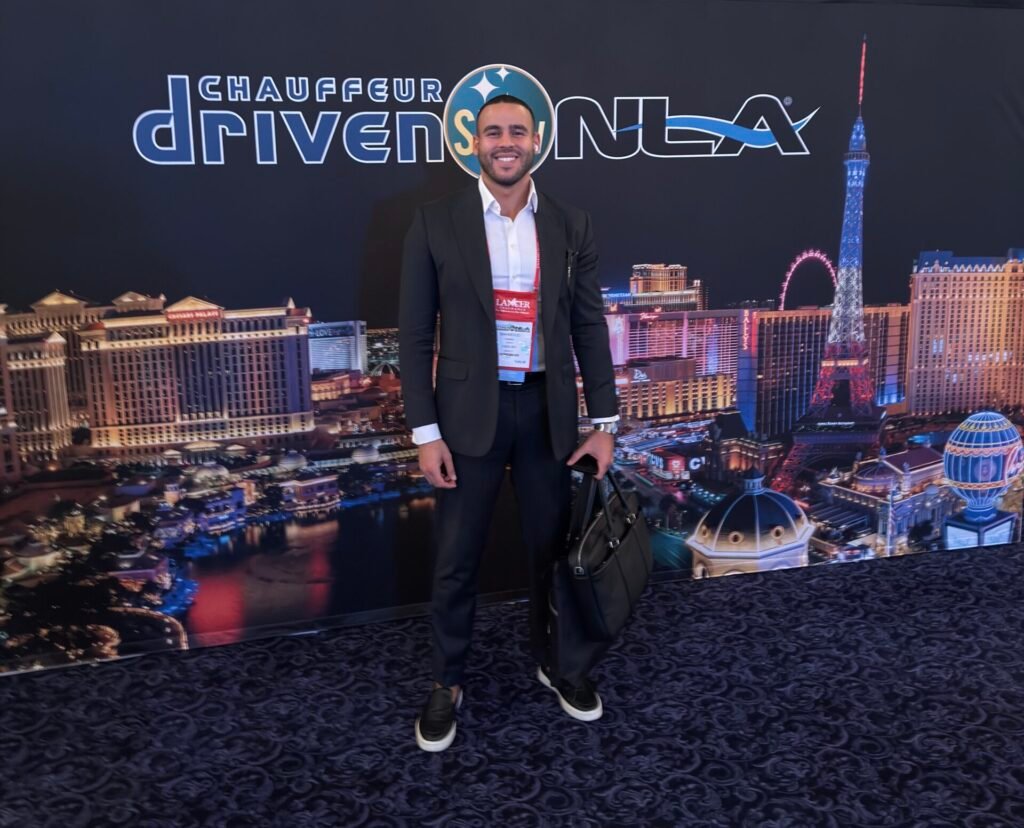
Mahmoud Hamid, founder of Miami-based Vimzi Limo, describes a similar pattern. Hamid, who founded the company in 2024 after years working as a professional chauffeur, has continued attending Chauffeur Driven and National Limousine Association events even as Vimzi has grown.
“It’s less about any single tactic I’ve picked up and more about seeing how differently operators in other markets solve the same problems I’m dealing with,” Hamid says. “It keeps you from assuming the way you’ve always done something is the only way to do it.”
The Standards Argument
There’s a second, quieter reason the best operators keep showing up: service standards drift when they’re only ever benchmarked against yourself. A company that’s genuinely excellent relative to its own history three years ago can still be quietly falling behind what the rest of the industry now considers baseline — flight tracking that’s actually automatic rather than occasional, communication that’s genuinely direct rather than routed through a queue, vehicle presentation that’s inspected rather than assumed.
Events are where that gap becomes visible. Not through a formal benchmarking session, but through the accumulation of small comparisons — the operator whose chauffeurs all mention the same specific pre-departure checklist without being prompted, the company whose booking confirmation process gets brought up unprompted by three different people as “the way it should work.”
“You come back from these things with a list,” the regional operator noted above says. “Not because anyone hands you one. Because you spent three days quietly noticing what everyone else treats as normal that you’d never thought to implement.”
What This Actually Costs an Operator Who Stops
The honest case against skipping events isn’t dramatic. Nothing collapses in a quarter. The cost is slower and less visible: a referral network that stops growing, service standards that quietly plateau at “good enough,” and a widening gap between what your company assumes is competitive and what the rest of the industry has actually moved to.
By the time that gap becomes visible in lost business, it’s already been compounding for years.
The Takeaway
Attending industry events isn’t a growth-stage activity that becomes optional once a company matures — if anything, the return increases as a company gets more insulated from outside perspective by its own success. The operators who keep showing up years after they’d have every excuse not to aren’t doing it out of habit. They’re doing it because the alternative is running a business that only ever gets compared to itself.